




 5 El Roser i Museu Parroquial
 5 El Roser i Museu Parroquial
 5 El Roser and Parish Museum
 5 El Roser und Pfarrmuseum
 5 El Roser et Museé Parroissele
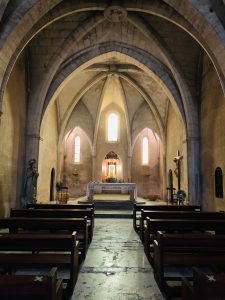
El Roser i Museu Parroquial
Es tracta de la primitiva parròquia i forma part del mateix conjunt arquitectònic. Construïda durant la primera meitat del segle XIV, d’estil propi de la transició entre el romànic i el gòtic, va ser un lloc habitual de refugi de la població durant les incursions pirates i aquest va ser el motiu pel qual es va fortificar. Cal destacar especialment la volta de creueria de l’interior de l’edifici.
Fulletó: http://visitcalafiguera.com/wp-content/uploads/2020/10/Guia-turi%CC%81stica.pdf
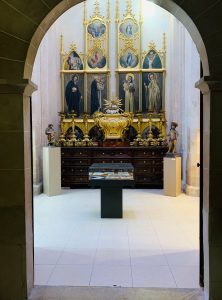
El Roser i Museo Parroquial
Es la parroquia primitiva y forma parte del mismo conjunto arquitectónico. Construido durante la primera mitad del siglo XIV, diseñado típico de la transición entre románico y gótico, era un lugar común de refugio de la población durante las incursiones piratas y por eso fue fortificado. Particularmente notable es la bóveda dentro del edificio.
Folleto: http://visitcalafiguera.com/wp-content/uploads/2020/10/Guia-turi%CC%81stica.pdf
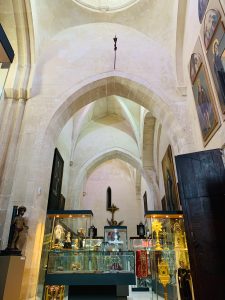
El Roser and Parish museum
Construction began on July 25, 1786, when rector Nicolau Pons laid the first stone of the new temple. This fact is the origin that the festivity of Santanyí is celebrated that day. The works lasted 25 years. It is a building built with Santanyí stone. Among its many attractions, such as the altarpiece of the chapels and the main altar, made by Pere A. Umbert, it is worth highlighting the monumental Baroque organ of the dominican convent of Palma, which came out after the unmortization promoted by Minister Mendizábal. The City Council of Santanyí bought the piece, which was moved by sea, brought to Cala Figuera and taken in cars to the church. The organ was so large that the building had to be modified to accommodate it. However, the original three keyboards could not be installed and only two were achieved.
The bell tower was built in 1850 on the initiative of the ionist Oliver de Can Lluc.
Leaflet: http://visitcalafiguera.com/wp-content/uploads/2020/10/Guia-turi%CC%81stica.pdf
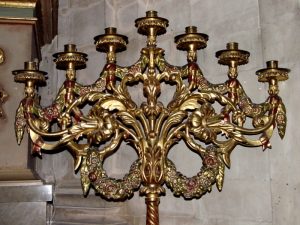
El Roser und Pfarrmuseum
Der Bau begann am 25. Juli 1786, als Rektor Nicolau Pons den grundstein für den neuen Tempel legte. Diese Tatsache ist der Ursprung, dass das Fest von Santanya an diesem Tag gefeiert wird. Die Arbeiten dauerten 25 Jahre. Es ist ein Gebäude aus Santanya-Stein gebaut. Unter den vielen Sehenswürdigkeiten, wie das Altarbild der Kapellen und der Hauptaltar, von Pere A. Umbert gemacht, lohnt es sich, die monumentale Barockorgel des Dominikanerklosters von Palma, die nach der Unmortisierung von Minister Mendiz-bal gefördert hervorgestellt. Der Stadtrat von Santanya kaufte das Stück, das auf dem Seeweg bewegt wurde, nach Cala Figuera gebracht und in Autos zur Kirche gebracht. Die Orgel war so groß, dass das Gebäude umgebaut werden musste, um es unterzubringen. Die ursprünglichen drei Tastaturen konnten jedoch nicht installiert werden und nur zwei wurden erreicht.
Der Glockenturm wurde 1850 auf Initiative des Ionisten Oliver de Can Lluc erbaut.
Prospekt: http://visitcalafiguera.com/wp-content/uploads/2020/10/Guia-turi%CC%81stica.pdf
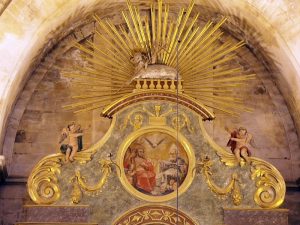
El Roser et Mussé Parroissele
La construction a commencé le 25 juillet 1786, lorsque le recteur Nicolau Pons a posé la première pierre du nouveau temple. C’est à cette origine que la fête de Santanyí est célébrée ce jour-là. Les travaux ont duré 25 ans. C’est un bâtiment construit avec de la pierre de Santanyí. Parmi ses nombreuses attractions, comme le retable des chapelles et l’autel principal, réalisé par Pere A. Umbert, il convient de souligner l’orgue baroque monumental du couvent dominicain de Palma, qui est sorti après la mémorisation promue par le ministre Mendizábal. Le conseil municipal de Santanyí a acheté la pièce, qui a été déplacée par la mer, a atterri à Cala Figuera et a pris dans des voitures à l’église. L’orgue était si grand que le bâtiment a dû être modifié pour l’accueillir. Cependant, les trois claviers d’origine n’ont pas pu être installés et seulement deux ont été réalisés.
Le clocher a été construit en 1850 à l’initiative de l’ioniste Oliver de Can Lluc.
Brochure: http://visitcalafiguera.com/wp-content/uploads/2020/10/Guia-turi%CC%81stica.pdf